KC Current
What Model Should Women’s Teams Use?

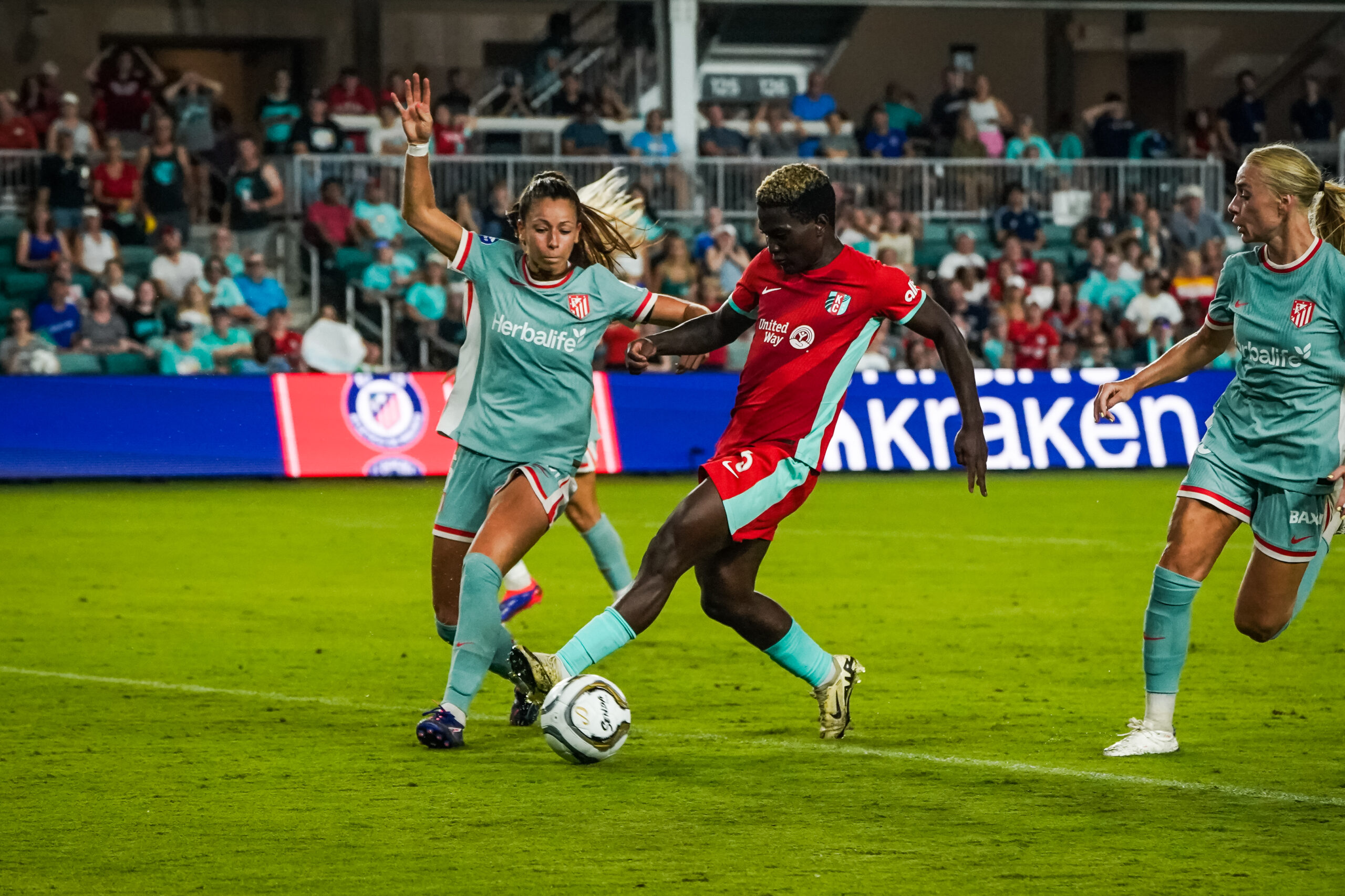
Last night I attended some middle school basketball games. As the 8th grade girls started to warm up, I noticed that it was going to be the Lady Grizzlies against the Lady Patriots. In both cases, the script on the front of their jerseys wrote “Lady” in highly stylized cursive and then Grizzlies/Patriots in much bolder block lettering.
Even though I knew better, when the boys game started afterward, I looked for the modifying word in front of the team names on their jerseys. I was curious if it was going to be something like the Gentleman Grizzlies against the Patriarchal Patriots. Of course, there were no gender descriptors on their tops.
Certainly, these types of designations have been commonplace ever since women and girls began competing in organized team sports. The boys get to be the mascot–often something fierce or inherently male (a bull or gamecock, a warring Trojan soldier, a lion with a mane), while the girls get to be the same thing just with “Lady” helpfully tacked on in front.
For a long time, women’s athletics were primarily the domain of high schools and colleges. In most of these places, the mascot would have been decided upon long before women had teams of their own and so the accepted convention was to designate the women’s teams as “Lady ___”. This century, though, and especially this decade, professional women’s sports teams have been rising in prominence leading different organizations to vary in their approaches.
Across the rest of the world, the highest profile women’s teams are all soccer and in most cases, the women’s teams operate under the same identities as preexisting men’s teams. A quick glance at the Opta Global Power Rankings for women’s football finds the top 8 thus: Chelsea, Barcelona, Lyon, Manchester City, Arsenal, Manchester United, KC Current, and Bayern Munich. If it wasn’t for the Current sitting there in the seventh spot, this could just as easily be a listing of the top men’s clubs in the world.
But of course these aren’t the full names for these teams as they are more specifically Chelsea FC Women, FC Barcelona Femení, etc. and they compete in leagues such as Frauen-Bundesliga, Women’s Super League, and the National Women’s Soccer League.
Contrasting this with domestic professional women’s teams tends to find a different approach. The two most successful women’s leagues in the US are for basketball and soccer and yet these leagues aren’t filled with the Los Angeles Lakers-Women or the Houston Dynamo-Women. While there may be some casual or online overlap, for example the LA Sparks share a color scheme with the Lakers and the Houston Dash’s website is a part of the Dynamo’s, the WNBA and NWSL teams are generally independent of any men’s teams. This is especially true in places like Las Vegas and Louisville where the Aces and Racing have no NBA or MLS counterparts, but there isn’t a single WNBA or NWSL team that feels like just an offshoot of a men’s team. (Though, certainly, many of the women’s teams in the US still use facilities that are primarily for men’s teams.)
So, which approach is better? Does the rest of the world have it right and women’s teams should come prepackaged as a female version of an existing men’s team? Or is the US model better and men’s and women’s professional teams should exist independent of each other?
Probably there isn’t a one-size-fits-all answer to this question. Undoubtedly, in Europe, where there is a century of history with most of these clubs that newer women’s teams can tap into, many of these teams have benefited from the brand recognition of what’s already been established. In the 2023-24 season, the Chelsea Women had an average attendance of 10,600. That’s still just a fraction of the 40,000 people that the men’s team averaged, but has been on a steady increase over the last few seasons. Would this women’s team be able to draw this many fans without many of them already being “Chelsea” fans? Perhaps. They are consistently one of the best teams in the world and employ some of the highest profile athletes: Sam Kerr, Alyssa Thompson, Naomi Girma. Interestingly, both Thompson and Girma played in front of more fans per match before they made the jump overseas as Angel City and San Diego Wave have higher attendance averages than Chelsea.
Admittedly, it’s not just butts in seats though as the alure of playing for a legendary club like Barcelona or Man U (despite the majority of that status is based on the history of the men’s teams) keeps drawing American athletes abroad and keeps analysists convinced the best soccer is played in Europe. Even though the women’s Champions League and Ballon d’Or have only been around a relatively small handful of years, there is still a lot of prestige that comes with competing for those titles (only a single NWSL player, Megan Rapinoe, has won the Ballon d’Or, and that was largely on the back of the US’s World Cup title). Perhaps the upcoming Women’s Club World Cup will start to change some of that, especially if American teams are able to win, but the NWSL will likely also have to alter their salary cap rules in order to retain their top talent.
There is one club, the London City Lionesses, who are testing a different model in European football. As of this May, they became the first independent (not attached to an existing…male…club) to be promoted to the Women’s Super League. About halfway through their first season in the top division, they sit in 6th out of the 12 teams. Their average attendance is only about 2,000 per match, but that’s not dramatically different than many of their counterparts. It will be very interesting to watch over the coming years to see if London City become a mainstay in the WSL, and, especially, if their success inspires any other “independent” European teams.
Connecting this conversation to our local teams, the question becomes, essentially, would the Kansas City Current have been better off instead being the Sporting Kansas City Women? Admittedly, SKC doesn’t have 100+ years of established brand power (in fact, of course, they have changed their identity multiple times over their first couple of decades in existence). Still, though, they are an MLS original and at the time the Longs were bringing an NWSL team to KC, Sporting was known as one of the most consistently good teams in the league. For years Sporting sold out every match at Children’s Mercy Park. In short, they were the primary soccer identity in the Heartland.
So why wasn’t the decision to create a female offshoot of SKC? It’s a rather jarring thought at this point as the Current have been very successful at carving out their own space in the Kansas City soccer landscape. However, if this was most other parts of the world, it would have been a foregone conclusion that a new women’s team would, in effect, be just the men’s team with a cursive “Lady” placed in front.
While there isn’t any way to really know, it’s an interesting question to ponder: would the Current have been more or less successful as the SKC-women? Success, obviously, can mean different things. Would they have won more games, more trophies? Would they have sold more tickets or more merchandise? Assuming it would have still been the Longs and Mahomes in charge, the roster and on-field results likely wouldn’t be particularly different. However, it’s hard to imagine the revenue/identity side being more successful than what’s happened over the last couple of years for the Current. This town embraces the teal and sells out CPKC Stadium. While Sporting still averages higher attendance numbers, it’s getting to the point where it is almost as likely to see a Current jersey or bumper sticker around the city as it is a Sporting one. If the Current, instead, just also used the same SKC logo, it doesn’t seem likely that they would have captured the attention of fans in quite the same way.
In other words, it pays to be your own thing.
Who knows if we’ll ever really achieve a level playing field for women’s sports, either in this country or around the world. Will there be a day when a professional league for women doesn’t have to also include “women” in their name? Sporting doesn’t play in the MLMS (Major League Men’s Soccer), nor the Oklahoma City Thunder in the MNBA.
Will the London Cities of the world prove that even in Europe, a women’s team doesn’t have to be a packaged deal with a men’s side? Will the WNBA, NWSL, PWHL, WPBL, etc. continue to make strides domestically in winning over fans and lucrative TV rights? Will there be a day when it’s not the Lady Patriots taking the floor in a middle school basketball game?
Again, who knows. But watching the Current on a big screen in The Dub while they play in their very own stadium feels like we’ve made some progress already.




Late goal drops Sporting KC in Seattle

KC Comets Schedule Released

Will the KC Current Make the Playoffs?

Preview: Sporting KC at Seattle – Can Wicky’s Rollercoaster Stay on the Rails?

Match Preview: Bay FC at KC Current

Sporting KC earns 2-0 win at Houston

Juice Boxes and Post Game Stats: Chawinga Reaches Half Century Mark for KC

A Red Card, Clean Sheet, Andre Luiz and Sporting KC
Preview: Sporting KC at Seattle – Can Wicky’s Rollercoaster Stay on the Rails?


I still wish SKC would have stepped in when FC KC was going through it’s trials and tribulations. We wouldn’t have had the exodus to Utah (no, that was a completely different franchise) and then the Return (wait, no, that was a completely new franchise – even though they kept the same players and didn’t get an expansion draft – I digress).
But the Current have definitely carved out a unique space, not only in KC, but in the world at this point. There shouldn’t have been a gap between NWSL franchises in KC, but you can’t argue it hasn’t ended well. And, honestly, I now kinda wish the Longs would take over SKC. Then maybe they would be the Male Current.
I DO wish the Current would just go ahead and put those two stars on their jersey. Or simply say the two in the crest don’t just represent two states, but two championships as well.
Great points! Even though it’s only been about a decade, we seem to be in a completely different era for women’s sports now than we were during the FCKC time. Part of the issue, absolutely, was the ownership group. But, regardless, more fans could have come out to support the two-time champion local team.
FCKC wasn’t SKC-Women, but it almost feels like it wasn’t as much of a brand in and of itself as the Current have become. To your point, I wonder if that team could have been saved had Sporting stepped in. Not that this is what you’re suggesting should have happened, but I do wonder if SKC-Women could have worked? As much as that’s the model in many other places, it hasn’t really been tried here.
But, yes, in the end the Current are undoubtedly in a better place now–complete with two stars!
I think SKC Women would have been stronger branding than FCKC had and especially when the problems started with ownership. However, as you point out, the current branding (yes, I did that) has been brilliant, beyond anything a hypothetical SKC Women would have been. Definitely an all’s well that ends well situation.
I can sort of see it both ways. There’s a certain sense to sharing branding with a men’s team if you think of it in the European multi-sport club model, and it makes for a simple message to fans and relatively unified merch/branding. On the other hand, I really enjoy the unique identities of teams like the Current when it’s done well. SO grateful they’re not Lady Sporting.
Well said! I didn’t mention that some of the high profile European soccer teams also have other sports under the same umbrella: for example, Real Madrid basketball. While the most well-known will almost always be the men’s soccer teams, it does allow for a simplicity when someone wants to be a fan of all the area teams at once. In a way, it’s similar to US university athletics. I could be a K-State fan of their football team, basketball teams, baseball teams, track teams, etc. and one Wildcat shirt will cover all the bases.
If we were to do that with professional sports in America, we could broaden this discussion to include not just the two KC soccer teams, but all the professional sports. The “Royals” could be the name for the local baseball, football, and two soccer teams…
Don’t forget, that was one of the explanations for the SKC name. They were going to be more of a sporting club like in Europe. I believe rugby and maybe lacrosse were mentioned initially. I don’t remember the particulars, but I think there were some noises about a rugby partnership at one point, but nothing concrete ever developed and they passed on the NWSL (potentially twice).