KC Current
KC Current Stadium Expansion Renderings and City Council Approval
Take a look at the proposed expansion of CPKC Stadium to 18,000 seats and learn about how much closer that is to a reality.

Announced all the way back on October 26, 2021, what would eventually become CPKC Stadium was revolutionary. A purpose-built stadium for professional women’s soccer. The first of its kind in the whole world.
A few short years later it would open and the Kansas City Current are actively in their third full season in the stadium. So far, it’s been a success on and off the field. The team has had the two best records in franchise history, including the best record in NWSL history last season. And the stands have been full. Every single NWSL league game has been a sellout of the 11,500-seat capacity.
A few weeks back, the KC Current announced the intention to add an additional 6,500 seats to bring capacity up to 18,000 seats. For comparison, that is just under cross-town (and state line) neighbors, Sporting Kansas City’s 18,467 seats.
However, in the NWSL, most of the stadiums are still larger than the Current’s, though none of the larger ones are currently exclusive to their teams. 18,000 would only put them ahead of Racing Louisville, North Carolina Courage and the Chicago Stars and would match exactly Bay FC’s shared home with the San Jose Earthquakes.
The plan has always been there to expand CPKC Stadium, but it took a step forward this week. The KC Current announced, “The Kansas City, Missouri City Council approved an ordinance that advances the next phase of development on the Missouri Riverfront, including an expanded CPKC Stadium to accommodate 18,000 fans and a new parking structure designed to improve accessibility and support continued growth along the riverfront.”
That doesn’t mean the deal is done.
The city and the Current have “agreed to discuss a framework that uses new revenues created through Current Landing to fund core riverfront infrastructure.”
The Cost
The Kansas City Current are asking for $235 million by creating a tax increment financing district. Often called a TIF district. That would capture sales and earnings taxes in the Berkley Riverfront area.
Importantly, the “plan does not immediately approve the money for the KC Current. It instead directs City Manager Mario Vasquez to negotiate with the team to reach a final deal. It also instructs Vasquez to apply for state tax breaks for the project.”
In addition to the $235 million, up to another $800 million in additional private investment could be sent into the next phase of development. Not just on the stadium and parking garage, but on Current Landing in general. When it’s all said and done, that could be $1.4 billion in investment in the riverfront just this decade.
“Today’s decision reflects Kansas City’s belief in bold ideas and transformational projects,” said Angie and Chris Long, co-founders and co-owners of the Kansas City Current. “This is an investment in Kansas City’s long-term growth and a commitment to building a destination that reflects this city’s ambition, inclusivity, and global momentum. We are proud to continue investing in Kansas City’s future and grateful for the partnership that makes this next chapter possible. The success of the Current and the Riverfront benefit our entire community, and we are honored to help create a lasting legacy for a city that has given so much to us.”
Public Funding?
The appeal for public dollars is a big change for the Longs. The original stadium, which cost $140 million, was mostly privately funded. There was a $5.5 million tax credit from Missouri’s Development Finance Board, which primarily went towards infrastructure.
Perhaps public money was mostly not available the first time around. Chris and Angie Long famously said most banks didn’t want to even finance them, so you could see city’s and state’s not jumping in to help. Perhaps with the leverage of the Kansas City Chiefs moving to Kansas, the city wants to do all it can to keep the Current, along with the KC Royals, happy.
Economists are clear, publicly financed stadiums aren’t a good investment. At least not dollar for dollar. Perhaps it’s all about being a “big city” that has nice things. That’s likely part of the reason for the massive investment of approximately $200 million that was spent locally directly on the World Cup.
Whatever the economics, now it’s up to the KC Current to fill the stadium if the expansion gets approved.
Stadium Renderings


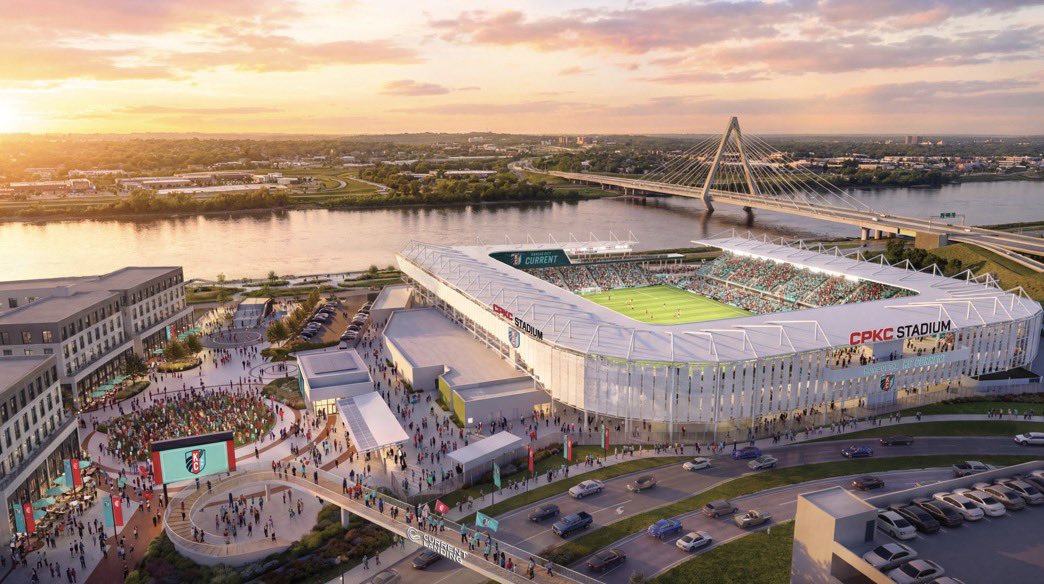
You can see from the released renderings that scoring a “river goal” is about to become a lot harder with the North end of the stadium’s view of the Missouri River mostly obstructed. A really bad shank could still send a ball towards the iconic Kit Bond Bridge which remains in view.
It’s hard to tell exactly where all 6,500 new seats are from the renderings, but as this expansion becomes closer to a reality, more specific details will surely be made available.




Juice Boxes and Post Game Stats: Setting a Club Record

Sporting KC misses the mark in Music City

Match Preview: KC Current at Utah Royals

Across State Lines: Del Fava Earns First Cap

Kansas City has a new king of soccer

Sporting KC Comeback from Two Goal Deficit to Steal a Point against Portland

Papering Over Cracks or Signs of Life? Sporting KC’s 3-3 Comeback Against Portland

Sporting Kansas City at Nashville SC: Opposite Ends of the Table Collide

Juice Boxes and Post Game Stats: Luiz’s Quick Start


I was wondering how they could approach 20k without closing in the north end. And it looks like they can’t. But I would get Populous working how to do it. Leave the river view. Iconic!
It would definitely be a loss not to have that view. I guess the compromise is keeping the bridge in view.
As I look at this, I’m wondering if all 6,500 seats are the North end plus filling in the Southwest and maybe Southeast corner? Is that possible? I couldn’t figure out where all the seats are.